Why I Chose the OlyLife TERA P90 for Chronic Knee Pain
This video shares the personal story behind why I chose the OlyLife TERA P90 for chronic knee pain after decades of knee problems, ACL reconstruction, inflammation, and walking limitations.
It is not a magic-cure story. It is my experience with a combination of diet changes, weight loss, metabolic health, PEMF, terahertz therapy, and consistent use of the TERA P90.

My Knee Pain Didn’t Start Overnight
Back in my teens and early twenties, I was a bit of a smart-arse athlete.
I played different sports, ran around, competed hard, and collected a box full of best-and-fairest trophies along the way. I expected my body to work because, at that stage, it mostly did.
Then one day, while playing mixed indoor netball, I caught the ball, landed in a straight line, and my right knee went snap.
The whole court heard it.
I dropped to the ground, leaned against the net, and knew something serious had happened.
That injury turned out to be a torn ACL. I later had an ACL reconstruction, followed by almost a year of rehabilitation, physiotherapy, strengthening, and trying to get the knee working properly again.
To be fair, the reconstruction worked reasonably well. I did not go back to football or netball, but I did return to cricket, which has always been a passion of mine.
I kept playing into my early forties, but I was no longer moving freely. Running became more of a hobble. The knee would hurt. Every now and again, I would twist it, aggravate it, or need another arthroscopy to clean things out.
For years, I was not really fixing the problem.
I was adapting around it.
The Cricket Match That Changed Everything
One of the best cricket matches of my life was also the day my knee really let me know it had had enough.
The day before the game, I had been working as a civil engineer. A large water pipe we were installing had filled with rubble, and I had to crawl inside it with a vacuum hose and clean it out.
By the time I finished, my knees were red raw.
Naturally, I played cricket the next day anyway.
I was the wicketkeeper and captain, looking after a team of Indians basically. Funny as. Our bowlers were getting smashed all over the park. I said can any of you blokes bowl at the fkn stumps??? Obviously not… Eventually, I threw down the gloves, grabbed the ball, and bowled off about a two-step run-up.
First ball, I bowled the batsman.
I ended up taking six wickets. Which i had never done before.

Then we went in to bat. I had to block out a good opening bowler, then later started scoring quickly once the change bowlers came on. I was on roughly 70 runs, having one of the best all-round games I had ever played.
Then, after hitting a bowler back over his head for six, I was jogging down the pitch giving him a bit of lip and my right knee collapsed underneath me.
That was it.
My teammates had to help carry me off the field. We lost the game, I missed out on what could have been a century, and one of my best cricket days effectively became the day my competitive sporting life ended.
That is one of the hard parts of chronic knee pain.
It does not just hurt.
It slowly takes pieces of your life away.
How Knee Pain Became Normal
After that cricket injury, I recovered enough to walk again, but things were not the same.
Walking became harder. Walking downstairs became especially painful. Eventually, instead of walking down stairs normally, I would turn sideways and take them one at a time.
That is not ideal when you are only in your early to mid-forties.
The surgeons were talking about knee replacement as the likely next step. I was not ready for that. I was still too young in my mind to accept that major surgery was the only direction available.
So I did what a lot of people probably do.
I sucked up the pain, grinned and bore it, and started organising my life around what my knee would allow me to do.
At the same time, years of eating a fairly standard Western diet were catching up with me.
I gradually put on weight. I had a decent-sized belly, skinny legs, and not enough muscle supporting a knee that was already badly compromised.
Looking back, I was dealing with signs of poor metabolic health, and that was not helping my joints, inflammation, energy, or recovery.
The knee was already damaged.
The extra weight and inflammation only made the situation harder to manage.
The Dog Incident That Made Things Worse
Then came the dog incident.
We had people over at my house, and my large Malinois was carrying on in his cage. I let him out on the lead, and he started sniffing around behind me.
I put my foot on the lead so I could bend down and pick it up.
Then he saw something, probably a butterfly or something equally important in dog logic, and jumped toward it.
The lead wrapped around my leg, knocked me off balance, and I went down with all my weight on the bad knee.
My heel went right back toward my backside.

The problem was, my knee did not bend that far anymore.
But it did that day.
The pain was extreme. Everyone thought I had gone down with a heart attack or something. I spent the rest of the day propped up in a reclining chair with ice on my knee while everyone else continued outside.
It took two or three months before I could properly put weight on that leg again.
And even now, I still cannot fully straighten that knee.
I was reluctant to go back to a surgeon because I feared the conversation would go straight back to knee replacement, and I was not ready to accept that as my only path.
The Staircase Moment: Something Had to Change
Eventually, I could walk again.
Not well.
But enough to get around.
Then one day, we went to a shopping centre where the parking was on the roof. We parked the car, walked over to the entrance, and the lift was broken.
There were three flights of stairs.
They were not particularly steep. They were not unusually deep. They were just normal stairs.
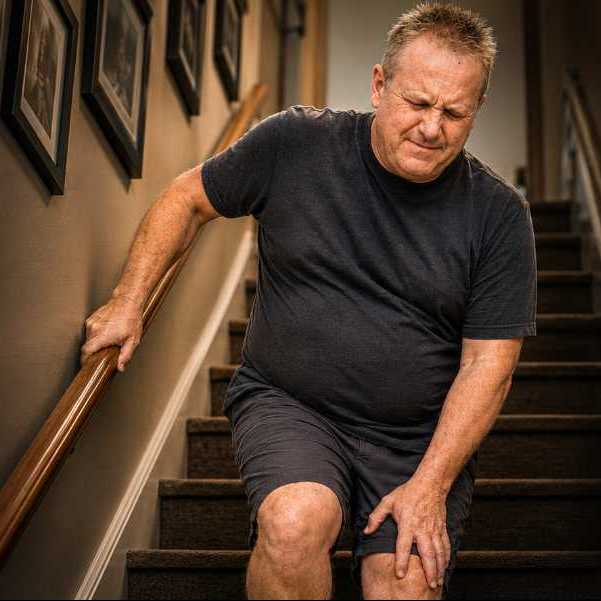
But I stood there with my left hand on the rail, already knowing how much every step down was going to hurt.
I knew I would have to go sidesaddle, one step at a time, trying not to put too much pressure through the knee.
And I remember thinking:
Something has to fkn change.
That was the moment I stopped treating the situation as something I simply had to tolerate.
The pain was not just pain anymore. It was affecting how I moved, what I was willing to do, and how small my life was becoming.
📢 Shareable Insight
“Chronic pain does not just hurt your body. Over time, it can quietly shrink your life until stairs, walks, movement, and normal daily activities become decisions instead of habits.”
👉 Click to Tweet
Why I Started With Diet, Weight Loss, and Inflammation
The first thing I looked at was not a machine.
It was me.
I knew I needed to lose weight. I knew sugar and carbohydrates were not helping my metabolic health. AND knew my knee always seemed swollen and inflamed.
So I started taking what I ate, and when I ate, much more seriously.
I moved toward a mostly carnivore way of eating, with meat, eggs, animal foods, the occasional avocado, some fermented foods, and a few other things that worked for me.
I also incorporated intermittent fasting.
When I ate enough protein and fat and stopped riding the sugar roller-coaster, fasting became much easier. I simply was not hungry all the time.
That helped.
I lost weight. The swelling improved. My inflammation seemed to calm down. I also started to understand how my body responded to different foods.
That does not mean I am perfect.
Life happens. Christmas happens. Bread rolls and doughnuts occasionally try to sneak back in and identify as a food group.
But I now understand how to get myself moving in the right direction again.
Diet and weight loss gave me a better foundation.
However, my knee still would not straighten properly.
It felt like I was walking on the ball of my foot with the knee slightly bent. That naturally created a limp, made walking inefficient, and put strain on everything around it.
So although improving my diet and metabolic health helped, I still wanted another practical layer I could add to my routine.
How I Found Frequency Therapy
That is when I started looking into frequency therapy.
I began reading about PEMF, terahertz therapy, and other wellness technologies people were using for pain, stiffness, recovery, and general support.
I went through a lot of testimonials.
And yes, I was skeptical.
Testimonials are useful, but anyone can say almost anything online.
What made the difference was that a trusted friend already owned an OlyLife TERA P90. He had physical issues of his own, I knew his situation, and he believed the device was helping him.
I spoke with him, asked questions, and tried to understand whether his experience could have any relevance to my knee.
That gave me enough confidence to try it.
I deliberately chose the standard P90 rather than the P90 Plus.
At that point, my primary concern was my knee. I did not think I needed the additional attachments or features because I was not having major problems elsewhere.
I was not expecting to wake up the next morning transformed into the twenty-year-old athlete I used to be.
Although that would have been bloody convenient.
Realistically, I hoped it might help me move with less discomfort, walk for longer without my knee swelling up, and stop feeling like one wrong turn could set everything off again.
Why I Chose the OlyLife TERA P90 for Chronic Knee Pain
The main reason I chose the OlyLife TERA P90 for chronic knee pain was practicality.
I did not want another complicated routine that would last two weeks and then disappear.
I wanted something I could use consistently at home.
The P90 could sit under my desk. I could use it while working on the computer, watching something, or doing normal daily tasks.
That mattered because consistency is usually where most health routines fall apart.
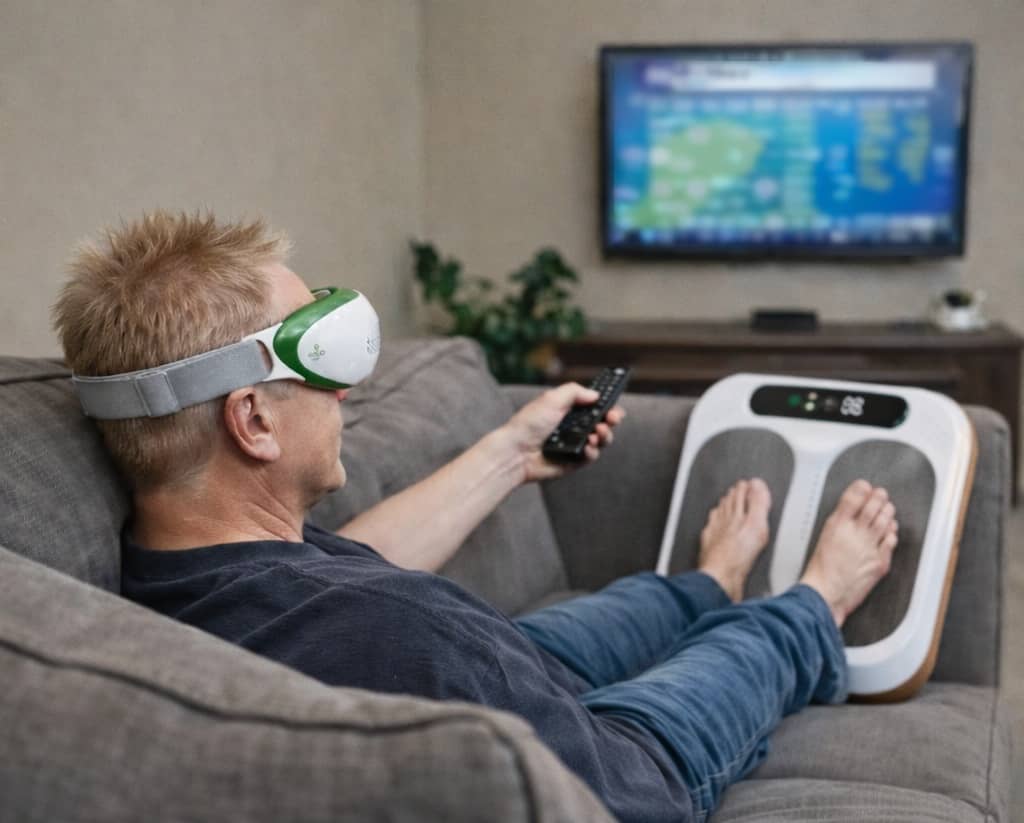
If something is too hard to use, too inconvenient, or too easy to avoid, it eventually becomes another expensive ornament.
The P90 was simple enough to become part of my day.
When I first used it, I started at intensity level two.
I could barely feel anything.
So naturally, being me, I thought, “Bugger this,” and turned it up to around level seven.
At that level, I could feel warmth developing through my legs and an unusual buzzing sensation. Afterward, it almost felt as though my legs were still lightly vibrating.
But one session was not the real test.
The real test was what would happen if I used it consistently.
So I kept it under my desk. I used it in the morning while working, and I often used it again later in the day at a slightly lower intensity.
It did not require an appointment. I did not have to drive anywhere. I did not need to rearrange my day.
It was simply there.
So I used it.

What I Noticed From Consistent Use
There was not one dramatic moment where I stood up and thought, “That instantly fixed everything.”
The change was more subtle than that.
I would walk into the kitchen and suddenly catch myself.
I would almost look around and think:
Did I not limp.
Before that, my knee would often bite without warning. I could turn, step awkwardly, or move in the wrong direction and get a sharp pain that made me catch myself.
Over time, I noticed that was happening far less often.
Sometimes it did not happen at all.
I could move around without constantly anticipating the next sharp pain.
Was that only because of the P90?
I cannot honestly claim that.
I was losing weight, eating differently, fasting, improving my metabolic health, and using frequency therapy consistently.
The combination made the difference, in my belief.
And that distinction matters.
I do not believe one machine replaces looking after your diet, body weight, movement, sleep, or general health.
But for me, frequency therapy became another useful layer in a routine that was finally moving me in the right direction.
📢 Shareable Insight
“The real breakthrough was not one magic moment. It was catching myself doing ordinary things, like walking to the kitchen, without the pain and limp I had accepted as normal.”
👉 Click to Tweet
Why I Don’t See the P90 as a Magic Fix
I want to be clear about this.
I am not saying the OlyLife TERA P90 magically cured my knee.
My knee still does not straighten completely. I still have weight I would like to lose. I’d still need to stay consistent with my diet, movement, and daily routine.
I can also tell when I stop doing the things that support me.
If I miss sessions, fall off my normal eating routine, or have a few too many foods that do not agree with me, I often notice inflammation beginning to creep back.
That is a constant reminder that, for me, this is a combination.
What I eat matters.
When I eat matters.
Managing my weight matters.
Supporting my metabolic health matters.
Using frequency therapy consistently matters.
And retraining myself to walk normally again matters.
After limping for so long, limping itself became a habit. Even when the pain was not there, my body still wanted to default to that old movement pattern.
Now I sometimes have to consciously remind myself to walk straight, stop favouring the knee, and use the leg properly.
That is progress.
Not perfection.
How I Learned the P90 Wasn’t Just a Foot Device
One thing I did not fully understand when I first bought the P90 was how many different ways people were using it.
I originally saw it as a foot device.
My knee was the main problem, so that was enough for me.
But after becoming more involved in the community and reading more personal experiences, I realised people were not only putting their feet on it.
Some people placed their hands directly on the pad. Others positioned it on their lap, bringing it closer to areas such as the hips, elbows, or shoulders.
That made me realise I had been thinking about it too narrowly.
I generally do not have major problems with my hands, although I did go through a period when my knuckles were clicking. From time to time, I placed my hands directly on the pad.
The clicking eventually settled down.
I cannot prove exactly what caused that, so I am not going to pretend the machine magically fixed my hands.
But it did help me understand how people were incorporating the P90 into a broader wellness routine rather than only thinking about their feet.
Why I Started Sharing My Experience
I did not decide to talk publicly about the P90 the moment I bought it.
I started talking about it after I had used it consistently, noticed meaningful changes in my own day-to-day life, and spent more time researching the field.
That research led me deeper into PEMF, terahertz therapy, red light therapy, EMS, TENS, and other technologies people were asking about.
I also realised something important.
Looking back, I wish somebody had sat down with me at the beginning and helped me understand the different options.
I spent days researching technologies, reading testimonials, and trying to work out what might make sense for my knee.
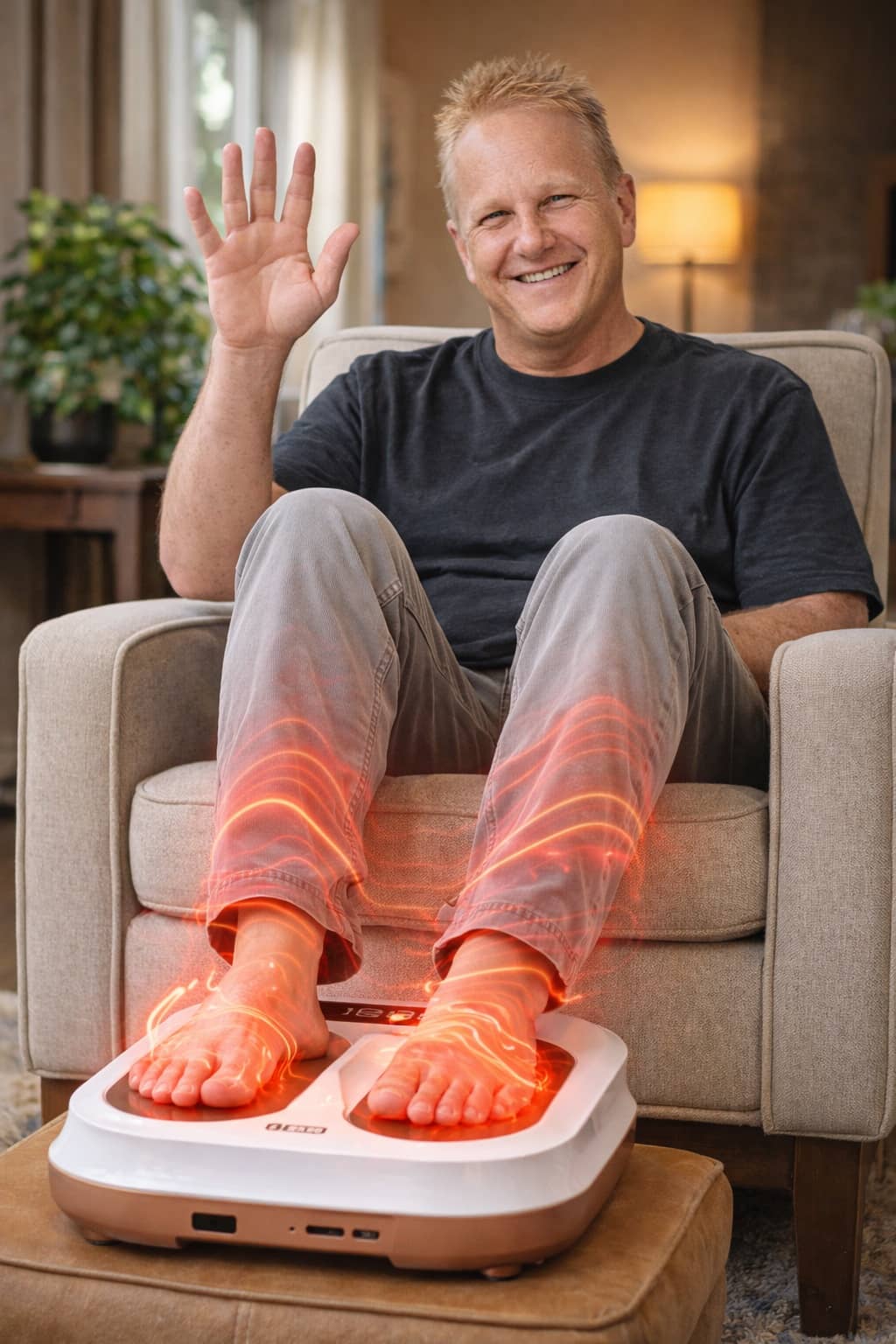
That research eventually became useful because I turned it into articles and videos that other people can access.
But my original decision would have been much easier if I had someone knowledgeable to talk it through with.
That is one of the reasons I now offer calls.
Not because every person needs the same device.
Not because frequency therapy is automatically right for every situation.
But because sometimes it helps to talk through what you are dealing with before spending money or heading down another rabbit hole.
Could Frequency Therapy Make Sense for You?
My experience explains why I chose the device I did.
It does not automatically mean frequency therapy, or the same device, is right for you and your situation.
If you are dealing with pain, stiffness, inflammation, limited movement, or poor recovery, and you are wondering whether PEMF, terahertz therapy, red light therapy, or another approach could be worth exploring, you can book a call with me.
We will have a straightforward conversation about what you are dealing with, what you have already tried, and what you are hoping to improve.
We can also talk about broader factors such as what and when you eat, your general lifestyle, and whether there are obvious areas worth investigating.
I am not a medical doctor.
I am not going to diagnose you.
And I am not going to promise that a particular device will magically solve your problem.
What I can do is listen, share what I have learned, explain the different options in plain English, and help you work out what questions you may need to answer before spending money on something that may or may not suit you.
There is no commitment to buy anything.
It is simply a conversation focused on your situation and what may be a sensible next step.
Final Thoughts on Why I Chose the OlyLife TERA P90
Choosing the OlyLife TERA P90 was not about chasing a miracle cure.
For me, it was about adding a practical, easy-to-use frequency therapy device into a broader routine that already included diet changes, weight loss, intermittent fasting, metabolic health improvements, and a willingness to stop accepting chronic knee pain as normal.
The P90 became part of that routine because I could actually use it consistently.
And consistency is where results usually begin.
My knee is not perfect.
But I move better than I did. The sharp biting pain happens far less often. I can walk more cleanly. I am no longer accepting that sideways stairs, constant limping, and daily restriction have to be the rest of my life.
That is why I chose the OlyLife TERA P90 for chronic knee pain.
And that is why I now help other people talk through whether frequency therapy, lifestyle changes, or another approach may make sense for them.
Important note: This post is based on my personal experience and research. It is not medical advice, diagnosis, treatment, or a promise that any device or routine will produce the same result for you. Always speak with an appropriate health professional before making medical decisions, especially if you have a diagnosed condition, implanted medical device, serious illness, or are under medical care.
Frequently Asked Questions
Why did you choose the OlyLife TERA P90 for chronic knee pain?
I chose the OlyLife TERA P90 for chronic knee pain because I wanted something practical that I could use consistently at home. My knee problems had built up over decades after an ACL reconstruction, arthroscopies, inflammation, stiffness, and recurring pain. I was already working on weight loss, diet, fasting, and metabolic health, but I wanted another layer of support that could fit into my daily routine.
Did the OlyLife TERA P90 cure your knee pain?
No. I do not claim that the OlyLife TERA P90 cured my knee pain. My improvement came from a combination of things, including diet changes, weight loss, better metabolic health, intermittent fasting, and consistent use of frequency therapy. The P90 became one useful part of a broader routine, not a magic fix.
What did you personally notice after using the OlyLife TERA P90?
The biggest thing I noticed was that I started catching myself walking more normally. There was not one sudden miracle moment. Instead, I would walk into the kitchen and realise I had not limped. I also noticed the sharp “bite” in my knee happened far less often when I stayed consistent with my routine.
How often did you use the OlyLife TERA P90?
I generally used the OlyLife TERA P90 twice a day when I was being consistent. I kept it under my desk, so I could use it while working on the computer, watching videos, or doing normal daily tasks. That convenience made it much easier to turn it into a habit.
Is the OlyLife TERA P90 only for feet?
I originally thought of the P90 mainly as a foot device. Later, after becoming more involved in the community and reading other people’s experiences, I realised people also placed their hands on it or positioned it closer to areas such as the hips, elbows, and shoulders. I still mostly use it for my feet and legs, but I now see it as more versatile than I first realised.
Why did you choose the standard P90 instead of the P90 Plus?
I chose the standard P90 because my main issue was my knee. At the time, I did not think I needed the additional attachments or extra features of the P90 Plus. That does not mean the standard P90 is the best option for everyone. It simply made sense for my situation at the time.
Can frequency therapy help with knee pain?
Frequency therapy, PEMF, terahertz therapy, red light therapy, EMS, and TENS are all areas people explore for pain, stiffness, recovery, and general wellness support. However, everyone’s situation is different. I share my personal experience because it helped me, but I do not claim it will produce the same result for everyone.
Should I buy an OlyLife TERA P90 if I have chronic knee pain?
Not automatically. Chronic knee pain can have many causes, and the right approach depends on your situation. Before spending money on any device, it makes sense to look at your pain history, diet, weight, inflammation, movement, lifestyle, and what you have already tried. That is why I recommend booking a call if you want to talk through whether frequency therapy may make sense for you.
Do I still need to look at diet and lifestyle if I use frequency therapy?
Yes, I believe diet and lifestyle still matter. In my own case, reducing sugar and carbohydrates, improving metabolic health, losing weight, and using intermittent fasting all played a role. The P90 was not a replacement for those things. It became another layer in a wider routine.
Can I book a call to talk through my own situation?
Yes. If you are dealing with pain, stiffness, inflammation, limited movement, or poor recovery and you are wondering whether PEMF, terahertz therapy, red light therapy, or another approach may be worth exploring, you can book a call with me. I am not a medical doctor, and I will not diagnose you, but I can help you talk through your situation, explain what I have learned, and help you think through sensible next steps.