
Free Backlink Opportunity Finder Without Paid SEO Tools
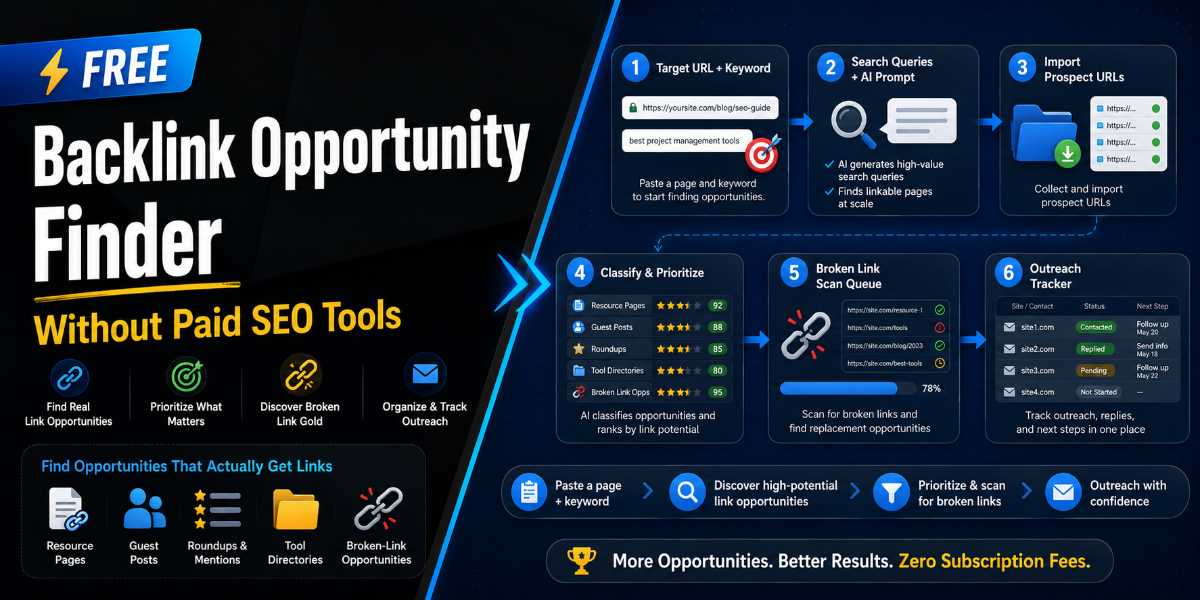
Building backlinks is easier when you know where to look. This free backlink opportunity finder helps you generate a practical AI prospecting prompt, uncover realistic link-building targets, extract clean URLs, and sort them into action buckets like quick wins, software directories, roundups, resource pages, broken link candidates, and guest post opportunities.

Free SEO Tool
Free Backlink Opportunity FinderWithout Paid SEO Tools
Paste your target URL, focus keyword, and link-worthy summary to generate backlink prospecting prompts, opportunity searches, and outreach angles.
Step 1
Set up the page you want backlinks to
Add the four core details first. The extra topics field is optional, but useful when your page fits more than one niche or audience.
Step 2
Generate your AI backlink prospecting prompt
One click creates a detailed prompt for ChatGPT, Claude, Gemini, or Perplexity with web search. The prompt asks AI to find backlink prospects, search footprints, outreach angles, and a plain URL list you can paste back into this tool.
After you generate the prompt, this area will show the simple next step.
Outreach angles will be requested inside the AI prompt instead of being split into separate tabs.
Step 3
Import the AI URL list
Paste the AI response or the plain URL list. The tool will extract URLs, remove duplicates, and give you a clean list to copy.
Backlink Action Plan
Work through the opportunities by action type
Start with quick submissions, then move into directory listings, roundup pitches, resource pages, guest posts, and lower-probability targets.
Paste an AI response above, then click Extract Clean URLs to create a clean URL list and action-based backlink plan.
Step 4
Get Backlinks — Submit, Pitch, Track & Follow Up
Now work through the backlink action buckets above. Start with the easiest links first, then move into outreach, follow-ups, and tracking.
How to work through the list
- Start with Quick Wins. Open each submission or listing site in a new tab. Look for submit tool, submit website, add listing, suggest a tool, or create account options.
- Check whether registration is needed. Some sites let you submit instantly. Others require an account, email confirmation, approval period, or profile setup.
- Move into directories and alternatives. Look for add product, suggest alternative, claim listing, or submit software options. Record login details if you create an account.
- Pitch roundups and resource pages. If the page already lists tools, tutorials, guides, or helpful links, send a short relevant pitch explaining why your page deserves to be added.
- Save broken-link checking for the right pages. Do not waste time checking every URL. Broken-link checking makes the most sense for resource pages, old guides, tutorial pages, and roundup posts.
- Follow up once. If you submit or pitch and hear nothing, follow up politely after a reasonable delay. Do not spam people.
Simple backlink workflow
Use this quick process as you work through each bucket.
- Open the prospect URL.
- Decide the action: submit, create account, pitch, check links, or skip.
- Record the URL in your tracker.
- Add the status: submitted, pitched, pending, approved, rejected, or follow-up needed.
- Set a follow-up date if outreach was required.
- Move to the next URL.
Step 5
Track Your Progress
Use a tracker so you do not lose prospects, forget login details, miss follow-ups, or submit the same site twice.
Backlink Opportunity Tracker
Use the tracker to record each backlink prospect, action bucket, submission status, contact page, login notes, follow-up date, result, and final backlink URL if approved.
Video walkthrough

Watch The Instructional Video HERE

Every Website Owners Nightmare – Building Backlinks…
Building backlinks can feel impossible when you are a blogger, content creator, small business owner, or solo website builder without access to expensive SEO software.
You know backlinks matter.
You know useful links from relevant websites can help search engines discover, trust, and rank your content.
However, when you start looking at tools like Ahrefs, Semrush, Moz, or other backlink research platforms, the monthly cost can be hard to justify. That is especially true if you are still growing your website, building your first tools, or trying to get traffic without throwing money at every shiny SEO subscription.
That is where a simple free backlink opportunity finder can help.
This tool does not magically build backlinks for you. It does not scrape thousands of websites, spam people, or pretend to replace proper SEO research tools. Instead, it gives you a practical workflow for finding realistic backlink opportunities, organising them into useful action buckets, and deciding what to do next.
You enter your target page details, generate a detailed AI prospecting prompt, paste the AI response back into the tool, extract clean URLs, and then work through the sorted backlink action plan.
It is simple, manual, practical, and designed for people who want to find backlink opportunities without paid SEO tools.
What Is a Backlink Opportunity Finder?
A backlink opportunity finder helps you discover websites, pages, directories, resource lists, blogs, and guides where your content may be worth mentioning.
The key word there is opportunity.
A backlink opportunity is not the same thing as a backlink. It is not a guarantee. It is simply a possible place where your page, tool, guide, article, video, or resource may genuinely add value.
For example, if you have created free online tools, a backlink opportunity could be:
- a tool directory that accepts submissions
- a blog post listing useful tools
- a resource page for bloggers
- a roundup of free marketing tools
- a broken link on an old guide where your tool is a good replacement
- a guest post opportunity where your tool could naturally be referenced
However, a poor backlink opportunity is just a random URL with no clear fit.
By contrast, a good backlink opportunity has context.
It should answer a simple question:
Would this page become more useful if it mentioned or linked to my resource?
If the answer is no, it is probably not worth chasing. If the answer is yes, you have a potential backlink prospect worth reviewing.
That is what this free backlink opportunity finder is designed to help with. It does not dump random links in front of you and call them “prospects.” It helps you create a more organised backlink research workflow so you can find pages that might actually make sense.
Why Backlink Building Is Hard Without Paid SEO Tools
Paid SEO tools are powerful. There is no point pretending otherwise.
Tools like Ahrefs, Semrush, Moz, Majestic, and similar platforms can show backlink profiles, competitor links, referring domains, anchor text, authority metrics, lost backlinks, broken backlinks, and loads of other useful data.
The problem is cost.
If your website is not making much money yet, paying for advanced SEO software can feel backwards. After all, you may need backlinks and traffic before you can justify the tool that helps you find backlinks and traffic in the first place.
As a result, many small website owners end up relying on manual search.
Manual searching can work, but it gets messy quickly. First, you open Google. Then, you try a few search operators. After that, you start copying URLs, checking pages, and trying to remember which sites looked promising. Before long, you have a random list of links, half-finished notes, and no clear idea which opportunities are actually worth pursuing.
AI can help with that process, but only if you give it a strong prompt.
For example, if you simply ask, “Find me backlinks,” you will often get a weak answer. It may return generic advice, repeated domains, dead pages, huge websites that will never reply, or lists of URLs that are not formatted properly.
That is where this tool fills the gap.
Instead of leaving you with a vague AI response, it helps you give AI a better research task. Then, once you have the results, it gives you a place to clean, extract, and organise the URLs into a more practical backlink workflow.
In other words, this free backlink opportunity finder gives you a useful middle ground. It is:
- better than random manual searching
- cheaper than paid backlink tools
- more structured than asking AI a vague question
- simple enough for bloggers and creators to use
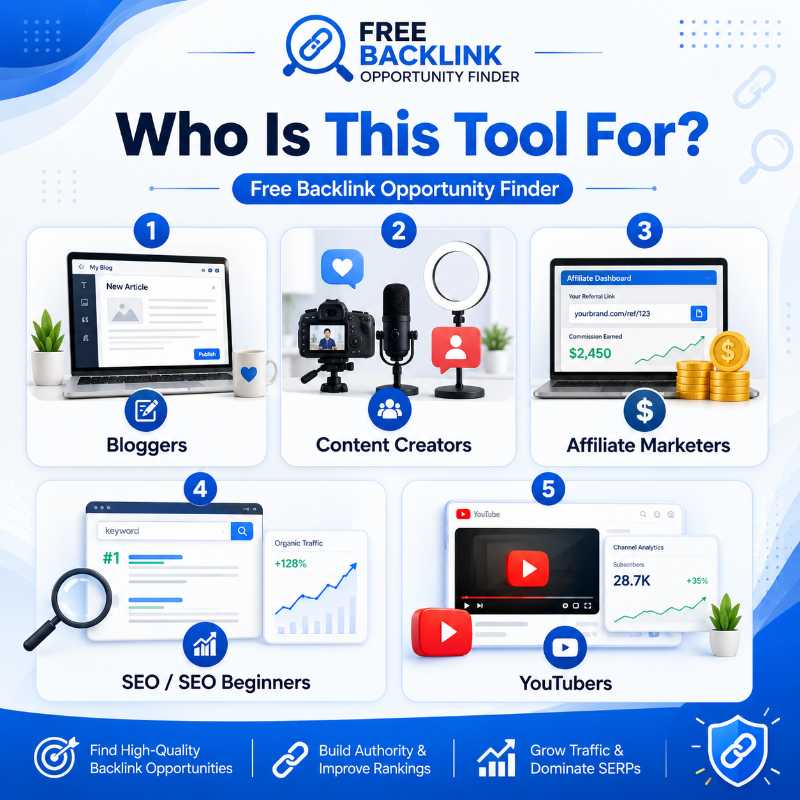
Who This Free Backlink Opportunity Finder Is For
This tool is best suited for people who are building links manually and want a more organised way to find prospects.
It is especially useful for:
- bloggers
- content creators
- affiliate marketers
- niche site owners
- SEO beginners
- small business owners
- online tool creators
- course creators
- website owners promoting useful resources
- people creating free tools, calculators, generators, or guides
It is also useful if you are building a content site and want to create a repeatable link-building workflow without buying expensive SEO software from day one.
However, this tool is not for everyone.
For agencies that need bulk prospecting at massive scale, it may feel too manual. Spam outreach teams will also find it too limited by design. Likewise, anyone trying to scrape the web aggressively or generate thousands of low-quality targets should use a different system.
In addition, this tool does not guarantee backlinks.
You still need to review each page, decide whether your resource fits, and send a useful message if outreach is required.
That is a good thing.
The best backlinks usually come from relevance, usefulness, and timing. Because of that, this tool helps you find potential places to start that process without pretending every URL is automatically worth chasing.
What This Tool Helps You Find
The Free Backlink Opportunity Finder helps you uncover different types of backlink prospects.
Some are easy wins. Others require outreach. Some might need manual review or a broken link check before you know whether they are worth pursuing.
The tool sorts opportunities into practical buckets so you know what action to take next.
The main opportunity types include:
- tool submission sites
- website submission pages
- software directories
- alternative listing pages
- roundup posts
- best-of articles
- resource pages
- useful links pages
- broken link candidates
- guest post opportunities
- contributor pages
- lower-probability but still relevant prospects
Because these opportunities require different actions, sorting matters.
For example, a tool submission page usually needs a direct form submission.
Meanwhile, software directories may require an account, product details, screenshots, or manual approval.
On the other hand, a resource page with broken links needs a different workflow from a best-of article that simply needs a polite inclusion pitch.
Without sorting, you end up with a pile of URLs and no clear next step.
With sorting, you can work through the list in a logical order.
Start with the easier wins. Then move into outreach. Then check resource pages for broken links. Finally, review the lower-probability targets when you have time.
How the Free Backlink Opportunity Finder Works
The tool follows a simple process.
It does not try to do everything automatically. Instead, it gives you a clean workflow you can follow each time you want to promote a page.
The basic process looks like this:
- Enter your target page details.
- Generate an AI backlink prospecting prompt.
- Copy the prompt into an AI tool with web search.
- Paste the AI response back into the tool.
- Extract clean URLs.
- Review the backlink action plan.
- Work through the buckets.
- Track your progress.
That might sound like a lot, but each step is simple.
The goal is not to make backlink building complicated. The goal is to stop it from being chaotic.
Step 1: Enter Your Target Page Details
The first step is to tell the tool what page you want to promote.
You can enter:
- Target URL
- Focus keyword
- Page title
- Page type
- Meta description or short summary
- Extra topics, niches, or audience angles
These fields help the AI understand what your page is about.
For example, imagine you are promoting a free QR code generator with logo support. You would not want AI to search only for “QR code.” That is too broad.
You may want it to understand extra angles such as:
- teachers using QR codes in classrooms
- restaurants using QR codes for menus
- bloggers creating QR codes for downloads
- small businesses needing free QR codes
- marketers adding logos to QR codes
Those extra topics can help the AI find more relevant prospects.

That is why the tool includes topic chips. After you analyse the target page, the tool creates topic chips from your URL, keyword, page title, page type, summary, and any extra topics you add.
You can add one extra topic at a time, press Enter, or add several topics separated by commas.
The point is simple: better inputs create better prospecting prompts.
Step 2: Generate the AI Backlink Prospecting Prompt
Once your page details are ready, the tool generates a detailed AI backlink prospecting prompt.
You can copy that prompt into ChatGPT, Claude, Gemini, Perplexity, or another AI assistant with web search.
The prompt tells AI what kind of opportunities to find. It asks for realistic prospects instead of random websites.
A weak prompt might say:
“Find me backlinks for this page.”
A stronger prompt says:
“Find realistic backlink opportunities for this specific page. Prioritise resource pages, tool directories, roundup posts, alternative listings, guest post opportunities, and useful links pages. Avoid spam directories, social media profiles, paid link farms, coupon sites, and irrelevant websites. Return live URLs with outreach angles and a clean URL list.”
That is a much better task.
The tool helps create that stronger prompt without you needing to write it from scratch every time.
Step 3: Paste the AI Response Back Into the Tool
After the AI gives you backlink opportunities, paste the response back into the tool.
The tool then extracts the URLs from the response.
This is useful because AI responses are often messy. They may include explanations, headings, bullet points, notes, and links mixed together.
The extractor pulls out the URLs, removes obvious duplicates, filters junk where possible, and creates a cleaner list you can work from.
This saves time.
Instead of manually copying each link one by one, you can paste the full AI response and let the tool extract the URL list.
You still need to review the results, but you start with a cleaner set of prospects.
Step 4: Review the Backlink Action Plan
After the URLs are extracted, the tool sorts them into a backlink action plan.
The action plan uses six buckets:
- Quick Wins: Submit Your Tool / Website
- Software Directories & Alternative Listings
- Roundup / Best-Of Inclusion Pitches
- Resource Pages / Broken Link Candidates
- Guest Post / Contributor Opportunities
- Lower Probability Targets
Each bucket tells you what to do next.
That is the real value of the tool.
Finding URLs is only one part of backlink building. Knowing what action to take with those URLs is where most people get stuck.
The action buckets help you avoid staring at a list of links wondering, “Now what?”
Quick Wins: Submit Your Tool or Website
The quick wins bucket is usually the best place to start.
These are pages where you may be able to submit your website, tool, product, or resource directly.
Look for phrases like:
- submit your tool
- add your website
- suggest a resource
- list your tool
- submit startup
- add listing
- submit app
- recommend a resource
These opportunities are usually lower friction than outreach.
Some sites may let you submit instantly. Others may require a free account, email confirmation, or manual approval.
Before you start, it helps to have your basic submission details ready:
- page name
- target URL
- short description
- category
- contact email
- logo or screenshot if needed
- main benefit of the page
- pricing if it is a tool or app
Do not submit to every directory blindly.
Only submit where your page genuinely fits.
A good submission is relevant. A spammy submission is just noise.

Software Directories and Alternative Listings
Software directories and alternative listing pages can be useful if you are promoting a tool, calculator, generator, web app, or online resource.
These sites often list products by category or compare alternatives to existing tools.
They may require more effort than quick-win submission pages.
You might need to:
- create an account
- claim a listing
- suggest a new tool
- submit product details
- add screenshots
- choose categories
- wait for approval
These links are not always easy, but they can be valuable.
They may send referral traffic, help people discover your tool, and create useful mentions across the web.
When approaching these sites, position your page clearly.
Do not just say, “Please list my website.”
Say what it does, who it helps, and why it is different.
For example:
“This is a free browser-based QR code generator that lets users add a logo or photo without creating an account.”
That is much stronger than:
“Here is my QR code tool.”
Roundup and Best-Of Inclusion Pitches
Roundup posts and best-of articles usually require outreach.
These pages already recommend tools, guides, products, or resources. Your job is to decide whether your page deserves to be included.
This is where relevance matters.
Do not pitch every roundup you find.
Open the page and ask:
- Does this article already mention similar resources?
- Is my page better, simpler, newer, or more useful?
- Is there a specific section where my page fits?
- Would the reader genuinely benefit?
- Can I explain the value in one or two sentences?
If the answer is yes, you can send a short inclusion pitch.
The message should mention the exact article and section.
For example:
“I noticed your section about free tools for teachers, and I thought my free QR code generator might fit because it lets teachers create QR codes with logos or images without signing up.”
That is specific.
A bad pitch says:
“Please add my link to your article.”
That is lazy.
A good pitch explains why the resource helps the reader.

Resource Pages and Broken Link Candidates
Resource pages are one of the most useful backlink prospect types.
They often exist specifically to help readers find helpful links, tools, references, guides, or recommended websites.
Examples include:
- teacher resource pages
- blogger resource pages
- small business resource lists
- university or school resource pages
- old useful links pages
- niche resource directories
- community resource pages
- old guides with lots of outbound links
These pages are especially useful for broken link building.
If a resource page links to an old tool, dead guide, deleted article, or expired website, your page may be a good replacement.
That is where the Free Broken Link Checker fits into the workflow.
Use the Backlink Opportunity Finder to discover possible resource pages. Then open promising pages and run them through the Free Broken Link Checker.
If the checker finds a real 404 or 410 link, review the context manually.
Do not pitch your page just because a link is broken.
Pitch your page only if it genuinely replaces the missing resource or improves the page.
This keeps your outreach helpful instead of spammy.
Guest Post and Contributor Opportunities
Guest post opportunities can work, but they need more judgement.
Do not treat every “write for us” page as a backlink target.
A good guest post opportunity should match your niche, your expertise, and the site’s audience.
Before pitching, check:
- Does the site still publish guest posts?
- Is the content quality decent?
- Is the audience relevant?
- Can you suggest a useful topic?
- Would your page fit naturally inside a helpful article?
Do not lead with:
“Can I get a backlink?”
Lead with a useful topic idea.
For example:
“I write about SEO tools for bloggers and had a few article ideas that may help your audience, including how to find backlink opportunities without paid tools.”
That is much better.
The backlink should fit naturally inside a useful contribution.
If it feels forced, skip it.
Lower Probability Targets
Lower probability targets are not useless, but they need more judgement.
These may include pages where the fit is weaker, the contact path is unclear, or the site is less likely to update old content.
Do not spend too much time here at the beginning.
Work through the stronger buckets first.
Once you have handled quick wins, directories, roundups, resource pages, and guest post opportunities, you can come back to lower-probability targets.
Sometimes you will find a hidden gem in this bucket.
Other times, you will decide the page is not worth chasing.
That is fine.
Good backlink building is partly about knowing what to skip.
📢 Shareable Insight
“Backlink building gets easier when you stop chasing random links and start looking for pages where your resource genuinely deserves to be mentioned.”
👉 Click to Tweet
Why This Tool Uses AI Prompting Instead of Fake Automation
This tool uses AI prompting because fully automated backlink prospecting often creates messy results.
A lot of automated tools try to look impressive by collecting huge numbers of URLs. However, a giant list of weak prospects is not very useful.
You do not need 10,000 random pages.
You need realistic opportunities where your page has a reason to be mentioned.
AI can help with research, search ideas, and prospect discovery. However, it still needs direction.
That is why this tool focuses on prompt quality.
The tool does not pretend to be a fake Ahrefs clone. It does not claim to show every competitor backlink. It does not calculate authority metrics or replace proper SEO software.
Instead, it helps you create a structured AI research task.
That makes the results more useful.
You still need to review the pages manually, but you start with a better list.
How to Use the Free Broken Link Checker With This Tool
The Free Backlink Opportunity Finder and the Free Broken Link Checker work well together.
They solve two different parts of the same workflow.
Backlink Opportunity Finder helps you discover pages worth reviewing.
The Broken Link Checker helps you test promising resource pages for broken outbound links.
Best workflow is simple:
- Use the Backlink Opportunity Finder to generate prospects.
- Review the Resource Pages / Broken Link Candidates bucket.
- Open a promising resource page.
- Paste that page into the Free Broken Link Checker.
- Check whether it has broken outbound links.
- If a real 404 or 410 appears, review the context.
- Use the outreach starter if your page is a good replacement.
The Broken Link Checker checks one page at a time.
That is deliberate.
One-page-at-a-time checking keeps the tool simple, reduces abuse, and helps protect free usage limits. It also encourages users to manually review pages instead of blindly blasting hundreds of URLs.
That makes the workflow safer and more useful.
What Makes a Good Backlink Opportunity?
A good backlink opportunity is not just any page that accepts links.
A good opportunity should be relevant.
It should have a reason for your page to exist there.
Use this checklist when reviewing prospects:
- Check whether the page is topically relevant.
- Look for existing links to external resources.
- Ask whether your page would genuinely help the reader.
- Confirm there is a clear contact, submission, or update path.
- Review whether the site looks legitimate.
- Check whether the page appears active, useful, or likely to get traffic.
- Avoid sites that look spammy, scraped, or overloaded with unrelated links.
- Make sure you can explain the value of your page in one sentence.
If you cannot explain why your page belongs there, skip it.
One relevant backlink opportunity is worth more than dozens of random weak ones.
A smaller niche website with a clear resource section can be more useful than a huge authority site that will never respond.
📢 Shareable Insight
“The best backlink opportunities are not the easiest links to get. They are the links that make sense for the reader, the page, and your resource.”
👉 Click to Tweet
What to Avoid When Looking for Backlink Opportunities
Not every link opportunity is worth chasing.
Some can waste your time. Others can make your site look spammy.
Avoid:
- paid link farms
- spam directories
- scraped content sites
- coupon pages
- irrelevant roundup posts
- private blog networks
- fake resource pages
- auto-approval junk directories
- social media profile links pretending to be backlinks
- pages with no realistic contact or submission path
Also avoid generic mass outreach.
If your email could be sent to 500 websites without changing a word, it is probably too generic.
Good outreach feels specific.
It shows the site owner that you actually looked at their page and understand where your resource fits.
Backlink Outreach Tips for Better Results
Backlink outreach does not need to be complicated.
In most cases, shorter is better.
Your message should answer three simple questions:
- Why are you contacting them?
- Where does your resource fit?
- Why would it help their readers?
Keep the tone friendly and low pressure.
Do not act like they owe you a backlink.
Do not send a giant essay.
Nor exaggerate your resource.
Do not pretend you are doing them a massive favour if the fit is weak.
A simple outreach message might look like this:
Example outreach email:
Hi [Name],
I found your post about [topic] and noticed your section on [specific section].
I created a free resource that may be useful there because it helps readers [benefit].
Here is the link if you want to take a look:
[URL]
No pressure at all. I just thought it might be a helpful fit for that section.
Regards,
[Your Name]
That is enough.
The Free Backlink Opportunity Finder includes an Outreach Playbook with message starters for:
- relevant resource suggestions
- better free alternatives
- broken link replacements
- guest post or contributor pitches
Use those examples as starting points. Then personalise them.
How to Track Backlink Opportunities Properly
If you are serious about link building, you need to track your work.
Do not rely on memory.
Once you start submitting tools, sending pitches, checking broken links, and following up, things get messy quickly.
Track details like:
- prospect URL
- domain
- opportunity bucket
- contact method
- submission page
- login details if needed
- date submitted
- date contacted
- follow-up date
- status
- result
- notes
- live backlink URL if approved
This helps you avoid duplicate outreach.
It also creates a reusable asset.
Excel or Google sheet files are attainable at the bottom of the tool window.
For example, if you successfully submit one free tool to 20 useful directories, you can come back later when you launch another tool and submit that new page to the same places.
That is where backlink building starts becoming more efficient.
You are no longer starting from zero every time.
Is This a Replacement for Ahrefs or Semrush?
No.
This tool is not a replacement for Ahrefs, Semrush, Moz, Majestic, or advanced SEO platforms.
Those tools have backlink databases, competitor research, authority metrics, historical data, link gap reports, and many other features this tool does not provide.
This tool is different.
It is for practical prospecting when you do not have paid SEO tools.
It helps you find realistic pages to review, organise those opportunities, and decide what action to take next.
That makes it useful for beginners, bloggers, tool creators, and small website owners who want a backlink workflow without a monthly software bill.
Think of it as a simple link-building assistant, not an enterprise SEO platform.
Best Use Cases for This Tool
This tool works best when you have something genuinely useful to promote.
For example:
- free online tools
- helpful calculators
- browser-based generators
- detailed guides
- useful tutorials
- niche resources
- comparison posts
- high-quality blog articles
- downloadable templates
- practical checklists
- video-supported resources
It is especially useful when your page solves a clear problem.
If your page is thin, generic, or not very useful, backlink outreach will be much harder.
Before chasing links, ask yourself:
Would I link to this page if someone else created it?
If the honest answer is no, improve the page first.
Better content makes backlink prospecting easier.
Final Thoughts: Find Better Backlink Opportunities Without Paid SEO Tools
Backlink building is not about collecting random URLs.
Instead, it is about finding pages where your content, tool, guide, or resource can genuinely improve the reader experience.
That is why this Free Backlink Opportunity Finder focuses on workflow, not hype.
First, it helps you enter your target page details. Then, it generates a stronger AI prospecting prompt. After that, it helps you extract clean URLs, sort opportunities into action buckets, and work through them in a practical order.
Start with quick wins.
Next, check software directories and alternative listings.
After that, review roundups, resource pages, broken link candidates, and guest post opportunities.
Along the way, track everything and skip weak matches.

When a resource page looks promising, use the Free Broken Link Checker to see whether any outbound links are broken.
Most importantly, though, remember this:
A backlink opportunity is only worth pursuing if your page genuinely deserves to be there.
If your resource helps readers, solves a problem, or improves the page in a meaningful way, this tool gives you a simple way to find more places where that resource may naturally belong.
Try the Free Backlink Opportunity Finder, use it with the Free Broken Link Checker, and start building a cleaner backlink outreach workflow without paying for expensive SEO tools.
Enjoy our complete suite of tools for Youtubers and Content Creators
👉 Go HERE for All The Free Tools
Frequently Asked Questions
What is a free backlink opportunity finder?
A free backlink opportunity finder is a tool or workflow that helps you discover websites that may realistically link to your content. Instead of guessing who to contact, it helps you find resource pages, tool lists, directories, roundups, guest post opportunities, broken link candidates, and other pages where your article, tool, or guide could genuinely add value.
The goal is not to collect random URLs. The goal is to find relevant pages where your resource fits naturally and gives the site owner a real reason to consider linking to it.
Does this tool build backlinks automatically?
No. This tool does not build backlinks automatically, and that is intentional. It helps you find, clean, sort, and organise possible backlink opportunities, but you still need to review each page manually.
Depending on the opportunity, your next step may be submitting your tool, contacting the site owner, suggesting your resource for a roundup, checking a page for broken links, or pitching a guest post. The tool gives you a practical action plan, but the backlink itself still depends on relevance, quality, outreach, and whether the website owner chooses to link.
Can I find backlink opportunities without paid SEO tools?
Yes, you can find solid backlink opportunities without paid SEO tools, especially if you use smart search prompts, manual review, resource page research, broken link checking, and organised tracking.
Paid SEO tools can speed up the process and provide backlink databases, authority metrics, competitor reports, and historical data. However, they are not the only way to find prospects. A free backlink workflow takes more judgement and manual effort, but it can still uncover realistic outreach targets if you filter out spam, irrelevant pages, and low-quality directories.
Can this replace Ahrefs, Semrush, or other paid SEO tools?
No. This tool is not a full replacement for Ahrefs, Semrush, Moz, Majestic, or other advanced SEO platforms. Those tools provide backlink databases, competitor analysis, referring domain reports, authority metrics, lost link data, and many other features.
This free backlink opportunity finder is different. It is designed to help bloggers, content creators, small business owners, and tool creators find realistic backlink prospects without paying for expensive software. Think of it as a guided backlink prospecting workflow, not a complete enterprise SEO suite.
What types of backlink opportunities should beginners look for first?
Beginners should usually start with opportunities that are easy to understand and simple to act on. Good starting points include resource pages, tool lists, niche directories, “best of” roundups, alternative listing pages, useful links pages, and broken link candidates.
These pages work well because they already link out to external resources. That means your job is not to convince someone to start linking externally. Your job is to show why your page, tool, or guide deserves to be included.
Why does the tool sort URLs into backlink opportunity buckets?
The tool sorts URLs into buckets because different backlink opportunities require different actions.
A tool submission page may simply need a form submission. A software directory may require an account or product listing. A roundup post may need a polite inclusion pitch. A resource page may be worth checking for broken links. A guest post page may need a topic pitch instead of a direct link request.
Sorting the URLs helps you avoid staring at a messy list and wondering what to do next. It turns backlink research into a more practical workflow.
What kind of URLs should I paste back into the tool?
You can paste the full AI response, a plain URL list, or any text that contains backlink opportunity URLs. The tool will extract clean URLs and sort them into action buckets.
For best results, ask the AI tool to include a clean URL list at the end of its response. That makes the import step easier and helps the tool organise the prospects more accurately. You should still manually review the extracted URLs before contacting anyone.
What makes a backlink opportunity worth pursuing?
A backlink opportunity is worth pursuing when the website is relevant, the page already has a reason to link out, and your content genuinely improves the page for readers.
Look for topical fit, useful content, editorial quality, active pages, and a natural reason your link belongs there. A smaller niche blog with a relevant resource page can sometimes be more useful than a huge general website with no realistic outreach path.
A good test is simple: if you cannot explain why your page helps their readers in one sentence, it probably is not a strong backlink opportunity.
How do I know if a backlink target is too spammy?
A backlink target may be too spammy if the site looks auto-generated, accepts every submission, has thin content, is overloaded with unrelated outbound links, or appears to exist mainly to sell links.
Be careful with directories that have no standards, blogs full of obvious filler, coupon pages, scraped content sites, and pages covering dozens of unrelated topics. A useful rule is this: if you would not want real readers discovering your brand from that page, it probably is not a backlink worth chasing.
Can I use this process for broken link building?
Yes. This process works well for broken link building when you combine the Backlink Opportunity Finder with a broken link checker.
The Backlink Opportunity Finder can help you discover resource pages, old guides, useful links pages, and roundup posts. Then you can check promising pages for broken outbound links. If you find a real 404 or 410 and your resource is a strong replacement, you can contact the site owner with a helpful message.
Broken link outreach works best when your replacement page genuinely matches the original topic. Do not pitch a random sales page just because a link is dead.
Are resource pages still good for backlink building?
Resource pages can still be useful when they are relevant, maintained, and helpful to readers. The best resource pages are usually topic-specific and list guides, tools, tutorials, checklists, references, or useful websites.
The mistake is treating every resource page as equal. A neglected page full of dead links may not be as valuable as a curated page managed by a real site owner. Before reaching out, check whether your content adds something useful, current, or missing from the page.
Can I use this workflow for guest post opportunities?
Yes, but guest post opportunities need more judgement. The goal is not to find every website with a “write for us” page. Many of those pages are low quality or overused.
A better approach is to look for relevant blogs that publish expert content, tutorials, interviews, contributor articles, or practical guides. Then pitch a specific topic that fits their audience. Guest posting works best when the article builds authority and helps readers, not when it exists only to force a backlink.
Should I contact every website the tool finds?
No. A backlink opportunity finder should give you a starting list, not a final outreach list.
You still need to manually review each website before contacting anyone. Remove spammy pages, irrelevant sites, dead websites, social profiles, coupon pages, scraped directories, and anything that does not make sense for your topic.
The best workflow is to collect prospects first, filter them second, and only contact the strongest opportunities.
How many backlink opportunities should I work through at a time?
It is usually better to work in focused batches instead of building a huge list you never use.
For example, you could find 20 to 50 possible prospects, review them carefully, shortlist the best ones, and then send a small batch of personalised outreach messages. This keeps the process manageable and helps you learn which types of websites respond.
Once you have a repeatable system, you can use it again for each new blog post, tool, guide, or resource page.
How should I track backlink opportunities after finding them?
You should track backlink opportunities in a simple spreadsheet or tracker. Useful columns include the prospect URL, website name, opportunity type, contact details, submission page, outreach status, follow-up date, response, result, and live backlink URL if approved.
Tracking stops you from contacting the same site twice, forgetting follow-ups, or losing good prospects. It also helps you build a reusable backlink database. If you successfully submit one tool to several directories, you can revisit those same sites when you publish another useful tool later.
What should I say in a backlink outreach email?
A good backlink outreach email should be short, specific, and useful. Mention the exact page you found, explain why you are contacting them, and show how your resource could help their readers.
Avoid long introductions, fake compliments, and pushy language. If you are reporting a broken link, lead with the broken link first, then offer your page as a possible replacement. If you are suggesting a resource, mention the section where it fits and explain the reader benefit in one sentence.
The easier you make the decision, the more likely someone is to reply.
What is the biggest mistake people make when looking for backlinks?
The biggest mistake is chasing volume instead of relevance. A long list of weak backlink prospects is not better than a smaller list of realistic, high-fit opportunities.
Many beginners also send the same generic outreach message to every website. That usually gets ignored. Better results come from reviewing each target, understanding why your page fits, and sending a short message that feels specific to that page.
Good backlink building is part research, part filtering, and part relationship building.


