
Why Calorie Counting Fails 95% of People – What Works Instead

Why Calorie Counting Fails (The Real Reason No One Tells You)
Most people turn to calorie counting because it seems simple, scientific, and easy to follow — but why calorie counting fails is a story almost no one is told. Beneath that simplicity is a strategy that almost guarantees long-term failure. Before we dive into the deeper science, it’s important to understand this:
Calorie counting doesn’t fail because you lack discipline — it fails because it’s built on outdated assumptions about how human metabolism actually works.
This article pulls back the curtain on why calorie counting collapses for 95% of people and what truly effective, sustainable fat loss looks like.
The Seductive Simplicity of Calorie Counting
Calorie counting is seductive because it feels like control. It’s neat, it’s measurable, and it promises results through discipline. You download an app, plug in your meals, watch the numbers add up, and feel like you’re finally doing something “right.”
On paper, it appears foolproof: burn more calories than you eat and you lose weight. Easy. But this seductive simplicity is exactly why so many people stay stuck. It’s the illusion of control—not actual control.
The truth is this:
Calorie counting oversimplifies a complex biological system. It turns food into math and your metabolism into a static machine. But you’re not a machine. You’re a living, adaptive organism.
And that’s why calorie counting works briefly… then fails spectacularly.
Why the “Calories In, Calories Out” Model Doesn’t Hold Up
The CICO model assumes that a calorie is a calorie and your body is a calculator. But the human body isn’t a spreadsheet—it’s a dynamic, adaptive metabolic system designed for survival.
And this is one of the core reasons why calorie counting fails for so many people:
1. Calorie Labels Can Be Off by Up to 20%
Food labels aren’t precise. They’re allowed a large margin of error. So the 250-calorie snack you logged might actually be 300—or 200. And restaurant meals? They can be off by even more.
2. You Don’t Absorb All Calories Equally
Your digestive system isn’t a copy-paste machine. The structure of food affects how many calories you absorb.
- Whole nuts vs nut oils absorb differently.
- Raw foods vs cooked foods use different energy to digest.
- Fiber-rich foods reduce net calories absorbed.
Two people can eat the same meal and absorb different calories.
3. Your Metabolism Adapts When You Diet
When you reduce calories, your body responds by:
- Lowering metabolic rate
- Increasing hunger hormones
- Decreasing satiety hormones
This is not willpower. It’s biology trying to protect you.
4. Exercise Isn’t a Fixed “Calories Burned” Number
Apple watches and treadmill screens give the illusion of precision—but they’re estimates. Two people doing the same workout will burn different amounts.
CICO works on a chalkboard. It doesn’t work in the real world.
5. What You Eat — and When You Eat It — Changes Your Hormonal Response
Here’s the part almost no one talks about: your body doesn’t just react to the amount of food you eat — it reacts to the timing and type of that food.
A sugary breakfast first thing in the morning spikes insulin (Foods That Spike Insulin). A late-night high-carb meal keeps you in fat-storage mode while you sleep. A protein-heavy meal (intermittent fasting) in the afternoon can stabilize your blood sugar for hours. The timing changes the hormonal outcome, and the hormonal outcome changes whether you burn fat or sugar.
Calories don’t tell you any of this. They don’t tell you when insulin rises, when fat burning shuts off, or when your body switches from burning stored fat to burning the bagel you just ate.
And this matters, big time — but we’ll get deeper into this pattern a little later.
📢 Shareable Insight
Counting calories turns food into math — while your body treats it like chemistry and survival.
👉 Click to Tweet
The Hidden Biological & Psychological Roadblocks
Even if you could track calories perfectly (you can’t), your biology and psychology would still get in the way. This is another major reason why calorie counting fails even for people who follow it with discipline.
Your Body Has a “Set Point”
Your metabolism is programmed to defend a certain range of weight. Drop below it too fast, and your body triggers:
- Increased hunger
- Slowed metabolism
- Lower energy expenditure
This is why dieting gets harder the longer you do it.
Hormones Dictate Hunger and Fat Storage
Calories matter—but hormones decide how your body uses them.
Key hormones include:
- Insulin: Signals fat storage
- Leptin: Signals fullness
- Ghrelin: Drives hunger
- Cortisol: Increases cravings and abdominal fat
You can eat fewer calories yet gain fat if your hormones are dysregulated.
Calorie Tracking Creates Psychological Burnout
Logging every bite:
- Turns eating into a job
- Creates guilt around “bad days”
- Encourages black-and-white thinking
- Can trigger obsessive or disordered patterns
Most people quit—not because they’re weak, but because calorie counting is unsustainable.
Ultra-Processed Foods Hijack Your Appetite
Even if you stick to calorie counting, ultra-processed foods:
- Increase cravings
- Trigger overeating
- Provide low satiety
Processed foods are engineered to bypass your natural fullness signals. Their calorie number becomes irrelevant.
What’s Really Behind the 95% Failure Rate
Studies vary, but the message is consistent: diets fail most people long-term.
Why? Because calorie counting:
- Treats symptoms, not root causes
- Relies on restriction, not habits
- Ignores metabolism, hormones, and biology
- Doesn’t change your relationship with food
- Creates short-term compliance but zero long-term transformation
People temporarily lose weight… but:
- Metabolism slows
- Hunger increases
- Stress rises
- Old habits return
Result: weight regain—often more than before.
This isn’t your fault. It’s the strategy’s fault.
What Works Instead: Quality, Habit & Bio-Individuality
To succeed long-term, you need a system built on how the body actually works.
1. Food Quality Over Calorie Quantity
Instead of obsessing over hitting a calorie target, focus on the types and ratios of foods you’re eating. Your metabolism reacts very differently to fat, protein, and carbohydrates.
- Protein triggers satiety, stabilizes blood sugar, and increases your metabolic rate.
- Healthy fats (animal fats, butter, eggs, tallow, olive oil) keep insulin low and fuel long-lasting energy.
- Carbohydrates—especially refined, processed carbs—cause the strongest insulin spikes and shut off fat burning.
Nutrient density matters, too. Whole, unprocessed foods provide vitamins, minerals, and amino acids your metabolism needs to function.
When you choose whole foods—especially higher protein and lower carbohydrate options—you naturally reduce cravings, lower insulin, and unlock fat burning.
2. Sustainable Habits Instead of Restriction
When you shift to a low‑carb, keto, or carnivore‑leaning diet, several things happen almost immediately:
- Your hunger drops dramatically
- Your insulin response becomes minimal
- You stabilize your blood sugar naturally
- Your body switches from burning sugar to burning stored fat
This isn’t magic — it’s physiology. Once insulin stays low long enough, your body finally gets permission to access stored fat. And because low‑carb ways of eating reduce cravings, this approach is easier, not harder, than restrictive calorie tracking.
3. Bio-Individuality Matters
Bio-individuality means your metabolism is unique. Your genetics, gut microbiome, hormone profile, stress levels, sleep patterns, and past diet history all influence how you respond to different foods.
Some people thrive on low‑carb diets. Others need moderate carbs with high protein. Some feel unstoppable on carnivore, while others perform best with a blend of protein, fats, and seasonal carbs.
There is no “one perfect human diet” — but there is a perfect diet for your biology.
Understanding your hunger patterns, energy levels, digestion, sleep, and mental clarity helps you tailor an eating style that works with your body instead of against it.
4. Tracking Should Be Feedback, Not a Lifelong Job
Tracking isn’t the enemy — obsession is.
Short-term tracking can be incredibly helpful for identifying patterns:
- Which foods spike your hunger
- Which meals keep you full the longest
- How your body reacts to carbs
- What your ketone levels look like as you adjust
But tracking should enhance awareness, not imprison you. You can track things like ketone levels or fasting glucose as tools, not rules.
Over time, your body becomes the feedback system.
My Personal Story: Why I Ditched Calorie Counting: Why I Ditched Calorie Counting
When I first tried to get healthy, I did what everyone does: I downloaded the apps, logged my food, scanned barcodes, weighed portions.
For a short time, it worked. But soon:
- I hit a plateau.
- I felt hungry constantly.
- I was tired, irritated, and mentally drained.
Worse, I felt like food was controlling me.
Then I realised something: I wasn’t overeating because I lacked willpower. I was overeating because my biology was fighting me the entire time.
I shifted my approach—focusing on:
- Metabolic health instead of calorie math
- Hormone balance instead of restriction
- Whole foods instead of processed ones
- Fasting windows instead of constant grazing
- Low‑insulin meals that actually allowed my body to burn fat
And that shift changed everything.
I wasn’t starving. Or counting. I wasn’t obsessing. For the first time in my adult life, I felt in control of my appetite instead of being controlled by it.
My energy increased. My cravings disappeared. AND mental clarity shot through the roof. And the weight? It started dropping WITHOUT the misery of calorie counting.
This experience became the foundation for what eventually turned into my 51‑Day Challenge—a metabolic reset that teaches you how to work with your biology instead of fighting against it.
📢 Shareable Insight
Your body doesn’t trust your calorie counter. It only trusts your hormones, hunger cues and recovery.
👉 Click to Tweet
Practical Steps to Shift From Counting to Creating Lasting Results
Here’s how you can break free from the calorie‑counting trap and build a system that actually lasts.
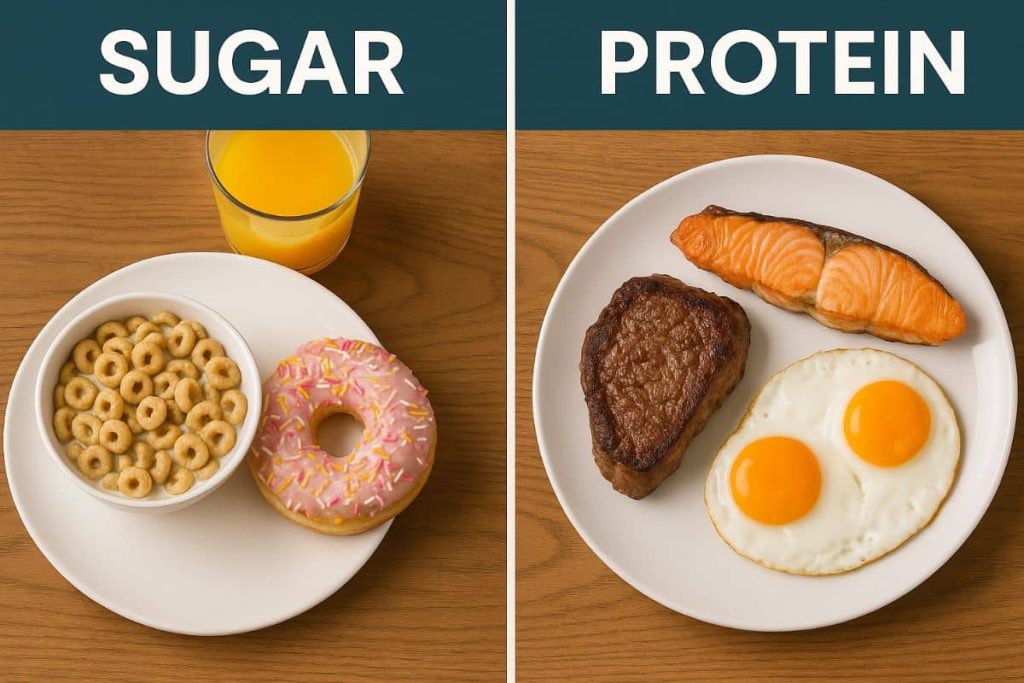
1. Build Your Meals Around Protein First
Protein stabilizes blood sugar, reduces cravings, and keeps you full for hours. Make it the anchor of every meal.
2. Eliminate Carbohydrates to Unlock Fat Burning
To truly lower insulin and keep your body in fat-burning mode, you don’t want to simply reduce carbs — you want to remove them as much as possible.
Carbohydrates — even whole-food sources and fruit — convert to glucose. Glucose triggers insulin. Insulin shuts off fat burning.
Eliminate the big offenders:
- Sugar
- Fruit (yes, the fructose still spikes insulin)
- Grains
- Bread, pasta, cereals
- Starches (potatoes, rice)
- “Healthy carbs” that still hit your bloodstream like sugar
Removing carbs removes the insulin spikes that block fat loss. This is why low-carb, keto, and carnivore diets work so powerfully — they biochemically shift you into fat-burning mode.
3. Embrace Healthy Fats Without Fear
Healthy fats are the backbone of a fat-burning, low-insulin lifestyle. When you remove carbs, your body needs a clean, reliable fuel source — and fat is exactly that.
Unlike carbohydrates, fats do not spike insulin. They keep you full, stabilize your energy, and support hormone production. They also make your meals satisfying so you don’t feel deprived.
Here are the best fat sources to build your meals around:
- Ribeye steak — the perfect natural blend of protein and fat for deep satiety and zero cravings.
- Fatty fish (salmon, sardines, mackerel) — packed with omega‑3s that reduce inflammation and support metabolic health.
- Eggs — nature’s multivitamin, complete with healthy fats, protein, and essential nutrients.
- Butter — rich in butyrate, which feeds your gut lining and keeps insulin low.
- Tallow and animal fats — extremely stable cooking fats that don’t oxidize and fuel clean-burning energy.
- Avocado — optional for those who tolerate plant foods well, offering a smooth, nutrient-dense fat source.

These foods help you stay full for hours without snacking, prevent energy crashes, and create the hormonal environment required for consistent fat burning.
Fat isn’t the villain — it’s the liberator from hunger, cravings, and metabolic chaos.
4. Use Intermittent Fasting as a Reset Tool
Intermittent fasting is one of the simplest and most powerful tools for lowering insulin, improving metabolic flexibility, and accelerating fat loss. You’re not depriving yourself — you’re giving your body time to burn through stored energy.
When you stop eating for a period of time, your insulin naturally drops. And when insulin is low, your body finally gains access to stored fat.
A simple 12–16 hour fasting window is enough to create measurable metabolic improvements. You don’t need to jump into extreme fasting to see results.
Here’s why fasting works so well:
- It lowers insulin quickly
- It burns through stored glycogen
- It encourages your body to switch from burning sugar to burning fat
- It gives your digestive system a break
- It stabilizes hunger signals and reduces cravings
Want even better results? Combine fasting with a low-carb or carnivore approach and your body will enter fat-burning mode even faster.
If you want to learn more about how fasting accelerates fat loss and restores metabolic health, check out this guide: Intermittent Fasting for Weight Loss & Metabolic Health.
5. Skip the Plate Templates — Keep It Even Simpler.
You don’t need plate templates when you’re eating in a metabolic-friendly way.
Your meals become straightforward:
- Protein (steak, eggs, fish, chicken, lamb)
- Fat (butter, tallow, egg yolks, fatty cuts of meat)
That’s it.
No fruit (fructose spikes insulin), no starchy carbs, no complicated meal-building rules.
This is simple, sustainable, and metabolically clean.
6. Add Daily Movement (Not for Burning Calories)
Walking after meals burns through the glycogen from your last meal, helping you switch into fat‑burning mode faster. It improves insulin sensitivity, lowers post‑meal glucose, and accelerates the transition from sugar‑burning to fat‑burning.
Movement also increases your energy demand—meaning more fuel required, which means more fat burned. Even gentle walking compounds over time.
Want to supercharge fat loss? Try fasted movement in the morning. Walking or light exercise while fasted taps directly into stored fat and trains your metabolism to prefer fat as its primary fuel source.
Light strength training, stretching, or mobility work also support metabolic health without requiring intense or lengthy gym sessions.
7. Track What Matters (Short‑Term Only)
Instead of calories, track:
- Hunger before meals
- Fullness after meals
- Energy levels
- Cravings
- Mood
- Ketone levels (optional)
Your body gives constant feedback. You just need to listen.
Conclusion: Why Calorie Counting Fails—and What Actually Works
Calorie counting fails not because people are weak, but because the method itself ignores reality:
- Hormones control hunger and fat storage.
- Food quality matters more than calorie quantity.
- Timing affects insulin and metabolism.
- Restriction backfires.
- Ultra‑processed foods hide sugars and refined carbs that spike insulin and keep you in fat‑storage mode.
The real solution isn’t to count harder. It’s to eat in a way that brings your hormones, metabolism, and hunger into alignment.
When you do that, fat loss happens naturally—without obsession, without math, without misery.
If you’re ready to break free from the calorie‑counting trap and finally unlock your metabolic potential, my 51‑Day Challenge will walk you step‑by‑step through the exact system that changed my life.
👉 Start Your Transformation Today
Your future self will thank you.


