
Almond Milk Inflammation: The Dark Side of Your Favorite Plant Milk

Exposing the hidden inflammation risks behind one of the world’s most popular “healthy” plant milks.
Almond milk has exploded in popularity over the last decade — but so has the rise of almond milk inflammation, a hidden issue most people never see coming. It’s marketed as a clean, dairy-free, heart-healthy alternative — the kind of choice you make when you’re trying to “do better” for your body. For years, I believed that too. Almond milk went into my coffee every morning without a second thought.
But then something happened. When I cut almond milk out of my diet for a month or two, the chronic knee pain I’d been dealing with for years practically disappeared. I thought it was just a fluke, so I reintroduced it to test things out — and within days, my joints were aching so badly I was struggling to walk. The only thing that changed was the almond milk. That’s when I realized: there’s a dark side to this so-called “healthy” plant milk that almost no one talks about.
Is Almond Milk Actually Healthy?
Almond milk has been brilliantly marketed as the saint of plant milks — low‑calorie, dairy‑free, and heart‑friendly. But a closer look tells a very different story.
Most people think they’re drinking a simple blend of almonds and water. In reality, most almond milk cartons contain:
- 2% almonds (yes, really, all the cruddy off cuts and discarded ones )
- Water
- Gums (gellan, guar, xanthan)
- Emulsifiers (sunflower lecithin, CMC)
- Acidity regulator (Tripotassium Citrate, Dipotassium Hydrogen Phosphate)
- Synthetic vitamins
- Sometimes seed oils
- “Natural Flavor” with means “whatever the fck they want to put in it.”
- Often added sugars
- Warning: CONTAINS ALMONDS, MAY CONTAIN OTHER TREE NUTS (boldly under the ingredients box.)
Almond milk isn’t almonds. It’s a highly processed imitation milk dressed up with health claims.
My Personal Experiment: Pain-Free… Until Almond Milk Returned
For years, I assumed my joint pain was just part of aging or overuse. But when I stopped drinking almond milk for a couple of months, something wild happened — my knees felt almost brand new.
I could walk easier. I could move better. AND I wasn’t wincing getting out of bed.
Then I reintroduced almond milk back into my coffee.
And my knees lit up.
Within days, I was limping around. Aching. Stiff. Struggling to walk. The only variable that changed? Almond milk inflammation.
That’s when I realized that sometimes the most “harmless” health foods can be the quietest triggers.
📢 Shareable Insight
Almond milk inflammation isn’t a myth — for many people, this “healthy” plant milk quietly fuels gut irritation, joint pain, and chronic inflammation.
👉 Click to Tweet
What’s Actually Causing the Inflammation?
Let’s break down the real culprits hiding inside almond milk.
Carrageenan: The Gut-Damaging Thickener
Carrageenan is used to improve texture and keep almond milk stable. But numerous studies show it can:
- Trigger gut inflammation
- Disrupt the intestinal lining
- Activate immune responses
- Increase intestinal permeability (aka “leaky gut”)
And gut inflammation doesn’t stay in the gut. It becomes systemic inflammation, which often shows up as joint pain.
Gums and Emulsifiers
These additives — used to mimic dairy creaminess — can:
- Disrupt the microbiome
- Thin the gut mucus barrier
- Cause bloating, cramping, and immune activation
For sensitive individuals or those with existing gut issues, this can absolutely translate into inflammatory joint flare-ups.

Seed Oils (Yes, They’re In Many Almond Milks)
Some brands add sunflower or canola oil to improve texture.
Seed oils are high in omega‑6 fatty acids, which promote inflammatory pathways when the omega‑6 to omega‑3 ratio gets out of balance.
If your joints hurt, this matters.
Learn more: Harmful effects of Seed oils
Added Sugars: The Metabolic Inflammation Trigger
Many almond milk brands contain 6–15 grams of added sugar per cup — especially vanilla, chocolate, and “original” blends. Even a seemingly harmless splash in coffee can add up quickly.
Why this matters:
- Sugar spikes blood glucose
- Spikes lead to insulin surges
- Repeated insulin surges create inflammatory cascades in the body
- High insulin = higher inflammatory markers
- Sugar also feeds gut dysbiosis, which ties right back to joint pain and immune activation
For anyone dealing with joint pain, metabolic issues, weight loss resistance, or gut problems, added sugars are a hidden but powerful inflammation trigger.
Unsweetened almond milk avoids the sugar — but still contains the additives and oxalates. So sugar isn’t the only problem… it’s just another one.
Learn more: Toxic effects of sugar
Also: Chocolate and Inflammation
Oxalates: The Hidden Issue No One Mentions
Almonds are extremely high in oxalates.
Oxalates:
- Stress the kidneys
- Contribute to stone formation in susceptible people
- Potentially aggravate inflammatory pain or stiffness
If you’re sensitive, almond milk may be pouring gasoline on that fire.
Why Some People React So Badly to Almond Milk
Not everyone will experience joint pain from almond milk — but many people do, and most never connect the dots.
You may react more strongly if you have:
- Gut issues (IBS, IBD, leaky gut)
- Autoimmune conditions
- Joint inflammation or arthritis
- High oxalate sensitivity
- Seed-oil intolerance
- A compromised microbiome
For these people, almond milk isn’t neutral. It’s inflammatory.
Related reading:
- Top 10 Toxic Foods Making You Fat and Sick
- Why Calorie Counting Fails 95% of People – What Works Instead
A Closer Look: Almond Milk Is Ultra-Processed
Despite its clean image, almond milk is anything but simple.
Ultra-processed foods aren’t just foods that go through a machine — they’re foods engineered, stabilized, flavored, thickened, preserved, and modified to look healthy while being anything but. Almond milk fits this description perfectly.
Here’s why almond milk qualifies as an ultra‑processed product:
- It contains multiple industrial additives: gums, emulsifiers, acidity regulators, stabilizers.
- The base ingredient — almonds — is only about 2% of the product.
- The rest is filtered water plus chemical additives to recreate the illusion of creaminess.
- Many brands add seed oils, giving it a richer texture that your body pays the price for.
- “Natural flavors” allow manufacturers to add virtually anything under a legal loophole.
- Synthetic vitamins are added to make the nutrition label look impressive.
This is the definition of an ultra‑processed food: something that resembles a whole food but behaves in your body like a lab‑designed product.
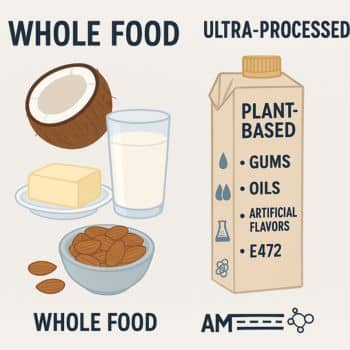
In fact, almond milk belongs in the same category as:
- Low‑fat flavored yogurts (packed with gums + sugar)
- “Healthy” granola bars (oil + sugar + additives)
- Fruit juices marketed as natural (but processed beyond recognition)
- Meal replacement shakes (lab-made formulas)
- Protein bars (a sugar bomb disguised as a health food)
It’s not inherently evil — but it is absolutely not the whole‑food, pure alternative that marketing makes it seem.
Also explore: This ONE Thing Stores More Fat Than Sugar Ever Could
Better Alternatives (If You Want to Avoid Inflammation)
If you still want plant-based milk:
- Homemade almond milk (still high oxalates, but clean)
- Natural coconut milk squeezed fresh from real coconut meat (NOT canned, NOT additive-filled)
- Macadamia milk (may be ultra‑processed as well — natural coconut milk is a better option)
If you tolerate dairy:
- Grass‑fed whole milk
- Heavy cream (simple, clean, and far less processed)
- Butter (plain, natural, no additives — far better than fake plant milks)
- Raw dairy (if permitted where you live)
Final Thoughts: Almond Milk Isn’t the Hero You Think It Is
For me, almond milk was a silent trigger.
Removing it reduced my inflammation. Reintroducing it brought the pain roaring back.
If you’re dealing with joint pain, stiffness, gut issues, or unexplained inflammation — almond milk might be worth eliminating for 30 days.
Your body might surprise you.
I’ll be adding almond milk — all varieties — to my Do Not Touch list.
📢 Shareable Insight
Almond milk is officially on my Do Not Touch list — here’s why.
👉 Click to Tweet
Transform Your Health with the 51‑Day Challenge
If almond milk is causing inflammation in your body, imagine what happens when you start removing all the hidden inflammatory triggers from your diet — and replace them with habits that actually heal your metabolism.
That’s exactly what the 51‑Day Challenge is designed to do.
Inside the challenge, you’ll:
- Reduce inflammation naturally (without supplements or fad diets)
- Drop stubborn kilos using simple, sustainable steps
- Reset your gut and improve digestion
- Boost energy, mental clarity, and metabolic flexibility
- Break free from addictive, ultra‑processed foods
- Build habits that actually stick — not willpower fantasies
This isn’t a “diet.” It’s a complete reset for your metabolism and your relationship with food.
👉 Join the 51‑Day Challenge here
Your Future Self will thank you…


